Well water filtration system cost in New Jersey: prices by problem
A well water filtration system costs $1,500 to $5,000 on average, installed, per the national cost guide HomeGuide. Across HomeGuide’s rows for acidic water, iron, a rotten egg smell and hardness, one system runs $800 to $3,500 installed. HomeGuide puts a typical multi-stage well setup at $3,000 to $7,000 installed. HomeBuddy’s range for a well water filtration system runs from $3,000 to $10,000 or more.
These are published market ranges, and a water test decides where your home lands. HomeGuide notes that more contaminants mean more stages, and more stages cost more. Our water treatment service starts with that test and sizes the system to the results. Estimates are free.
Well water filtration system cost by problem
HomeGuide’s April 2026 guide prices each system by the problem it fixes. Installed means the equipment plus labor. Every figure in this table comes from that guide.
| What the water test shows | Usual system | Published installed range |
|---|---|---|
| Sand, grit or cloudy water | Sediment filter | $150 to $500 |
| Acidic water (low pH) | Acid neutralizer (calcite tank) | $800 to $2,500 |
| Orange, brown or black stains | Iron and manganese filter | $1,000 to $3,500 |
| Rotten egg smell | Air injection or carbon filter | $800 to $3,500 |
| Bacteria or coliform | UV disinfection | $700 to $2,500 |
| Hard water and scale | Water softener | $1,000 to $3,500 |
| Nitrate | Reverse osmosis or anion exchange | $300 to $5,000 |
| Nitrate or radium, kitchen tap only | Under-sink reverse osmosis | $200 to $600, unit only |
| Taste, odor or chemicals | Whole house carbon filter | $600 to $2,000 |
Labor is part of those installed prices. HomeGuide says professional installation adds $200 to $2,000 to the total project cost. Systems that backwash, like iron filters and softeners, need a drain connection. UV systems need a dedicated electrical outlet.
The softener row is the short version. Our guide on what a water softener costs to install prices softeners by type. A rotten egg smell has more than one possible source. Read why well water smells like rotten eggs before you buy a sulfur filter.
We install acid neutralizers, iron filters, sulfur removal, UV disinfection, sediment and whole house filtration, and softeners. Reverse osmosis and anion exchange are the other options in the table.
Why do South Jersey wells need two or three stages?
Most mainland wells here draw from the shallow Kirkwood-Cohansey sands. The U.S. Geological Survey describes that water as typically acidic and soft. It rates the water highly corrosive. That acidic water usually carries iron, which leaves orange stains and eats copper.
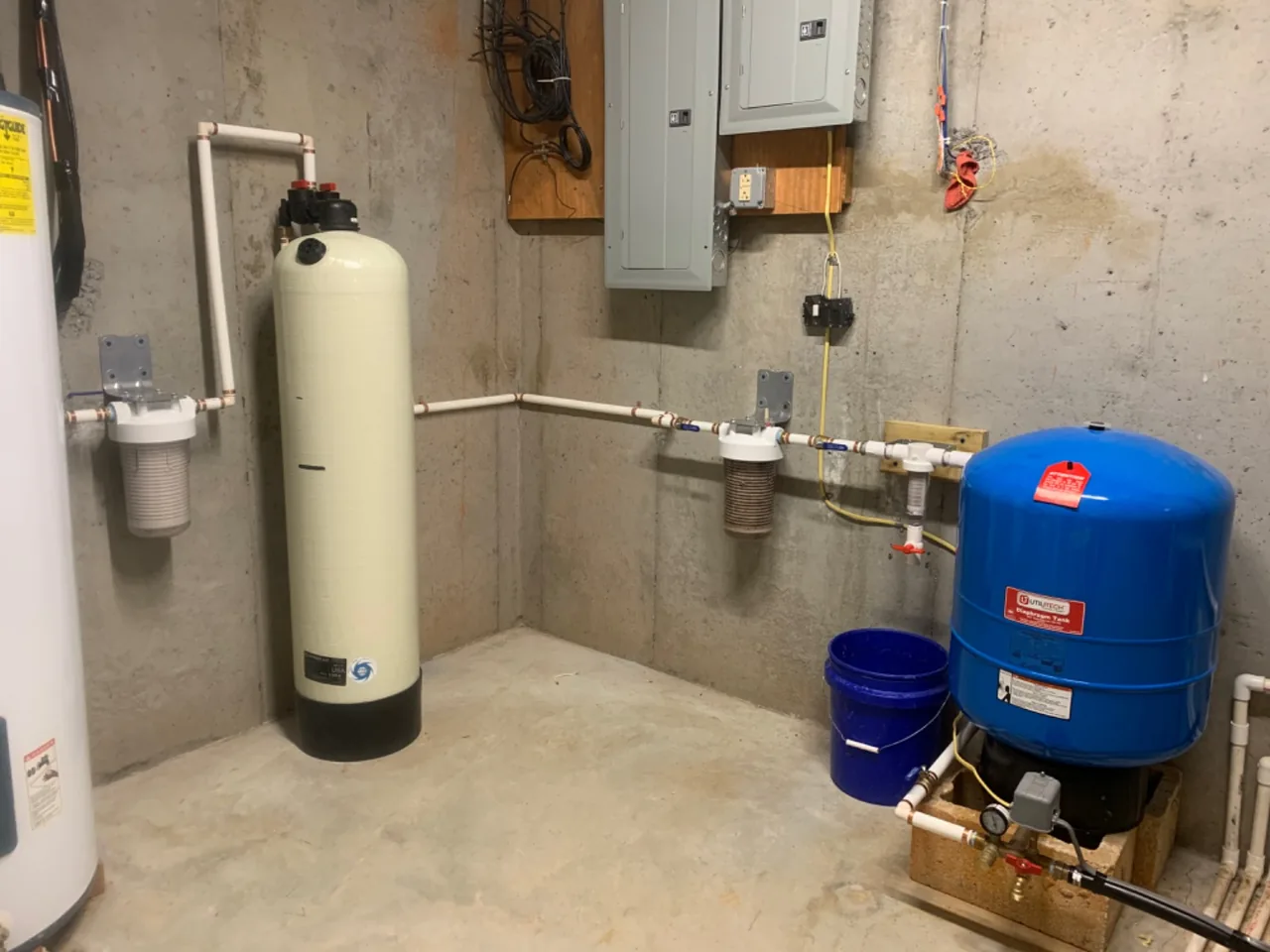
HomeBuddy notes that well homes often need treatment for iron, sulfur, bacteria and sediment, usually in several stages. HomeGuide lists the usual order. A sediment filter goes first, then an acid neutralizer if needed, then an iron filter. A softener comes next, then UV disinfection. Each system protects the one after it.
The order has reasons behind it. HomeGuide lists a birm iron filter as best for water above pH 6.8. So the neutralizer raises the pH first. UV sits last because it needs clear, sediment-free water to work. A calcite neutralizer also adds hardness as it dissolves, per Penn State Extension. Penn State calls that necessary for proper corrosion control, and a softener stage can handle any scale that follows.
Each stage also costs a little water pressure. HomeGuide calls a drop of 2 to 10 PSI per system normal. With several systems, it says to check that the well pump and pressure tank can handle the load. A constant pressure system or larger pressure tank adds $500 to $2,000 when one is needed. That work is our well pump and pressure tank service, and the estimate is free.
What else moves the price?
Where the water gets treated changes the price a lot. HomeGuide says whole house systems cost 3 to 10 times more than point-of-use units. It says iron, hardness, sediment and a sulfur smell affect the whole home, so those call for whole house treatment. Nitrate, arsenic and lead can often be handled by a cheaper reverse osmosis unit at the kitchen sink, per HomeGuide. For radium, the state adds a caution. A kitchen unit treats one tap, and exposure may continue from the other taps.
Household size moves the price too. HomeGuide says well systems are sized to your peak flow, in gallons per minute. A two-bathroom home typically needs 7 to 10 gallons per minute. A four-bathroom home may need 12 to 15 or more. Bigger tanks and valves cost more. Moving from a 10-inch tank to a 13-inch tank can add $200 to $500 per system.
Equipment grade matters as well. HomeGuide puts budget systems from online retailers at $300 to $1,500. It puts premium units at $1,000 to $4,000 or more per system.
What does radium treatment cost in South Jersey?
The state health department says many wells in South Jersey are vulnerable to radium. Radium has no smell, color or taste, so only a test finds it. The state names water softeners and reverse osmosis as effective radium treatments.
The state calls a water softener a cost-effective option at $800 to $1,500 for the average home. An under-sink reverse osmosis unit costs $200 to $600, per HomeGuide. Whole house reverse osmosis runs $4,000 to $10,000 installed, per HomeGuide. The state calls whole house versions expensive.
Treatment only works while it is maintained. In the state’s outreach sampling, 27 percent of water treatment systems did not reduce radioactivity to safe levels. The state points to poor maintenance as the likely cause. For softener owners, its advice is to monitor salt levels in the brine tank. Our water softener installation service sizes each softener to a water test, and estimates are free.
What does a well water filtration system cost to keep running?
Upkeep starts in the first year. HomeBuddy says most homeowners spend around $100 to $300 a year on replacement filters. HomeGuide puts annual maintenance at $100 to $500 on average, depending on the type and number of systems. It warns that skipped maintenance leads to poor filtration and early equipment failure.
Each stage has its own schedule, per HomeGuide. Sediment cartridges cost $5 to $30 each and need changing every one to three months. A UV lamp needs replacing every year, at $50 to $150. Iron filter media lasts 5 to 10 years and costs $200 to $600 to replace.
A calcite neutralizer tank gets refilled as the media dissolves. Penn State Extension says the refill rate can range from weeks to months. It depends on how corrosive your water is and how much you use. We handle media swaps and filter changes on the systems we install.
Test the water before you price a system
A water test decides which rows of the table apply to your well. HomeGuide puts a test to choose the right system at $100 to $300. Its well guide says never to buy a system based on guesswork. We test well water first, then quote the treatment the results call for.
New Jersey also requires a test when a home with a private well is sold. The Private Well Testing Act requires buyers and sellers to test and review the results before closing. Our guide on how often to test well water in New Jersey covers the yearly schedule and the law.
Help paying for well water treatment
New Jersey has a loan for this. The Housing and Mortgage Finance Agency’s Potable Water Loan Fund offers no-interest second mortgage loans up to $10,000. The loans are for single-family homes with wells that don’t meet primary drinking water standards. The state’s radium pamphlet points well owners to the same program for treatment financing.
Our estimates are free, so you can price the system before you apply. Call (856) 207-7373 for a free estimate anywhere in Gloucester, Cumberland, Salem, Atlantic, Camden or Cape May County.