How much does water softener installation cost in New Jersey?
Water softener installation cost runs about $1,100 to $3,000 installed, per the national cost guide Fixr. Fixr sets the national average at $2,500. HomeBuddy prices the most popular setup, a single tank salt-based softener, at $1,200 to $3,800 installed. These are published market figures, and your own price comes from a free estimate.
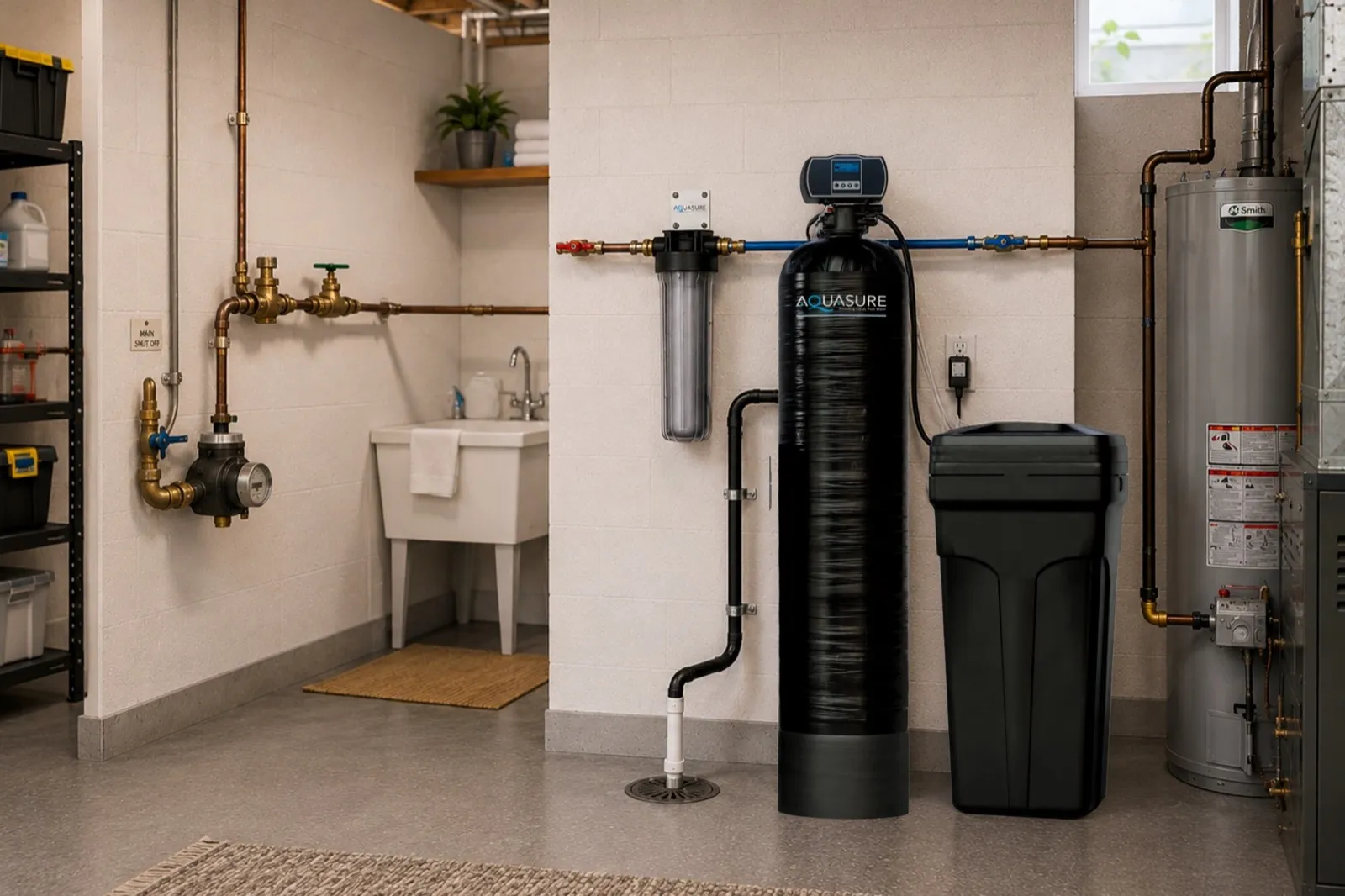
New Jersey adds a number of its own. The state health department calls a water softener a cost-effective option at $800 to $1,500 for the average home. The reason is radium, which softeners reduce in South Jersey well water. Our water softener installation service sizes each unit to a water test, and the estimate is free.
Water softener cost by type
Two national cost guides publish the ranges below. Installed means the unit plus labor. Unit only means the equipment before labor.
| Softener type or job | Published range | Source |
|---|---|---|
| Whole house softener, typical install | $1,100 to $3,000 installed | Fixr |
| Single tank salt-based | $650 to $1,500 installed | Fixr |
| Single tank salt-based, most popular setup | $1,200 to $3,800 installed | HomeBuddy |
| Twin tank (dual tank) | $1,500 to $3,000 installed | Fixr |
| Salt-free conditioner | $500 to $3,000, unit only | HomeBuddy |
| Softener replacement | $700 to $1,000 | Fixr |
| Major repair, control valve or resin tank | $150 to $600 | HomeBuddy |
| Hauling away the old unit | adds $50 to $100 | Fixr |
The two guides split on single tank prices. Fixr tops out at $1,500, while HomeBuddy starts at $1,200 and runs to $3,800. For well homes, Fixr prices a typical well water softener at $500 to $2,000 for the unit alone. Your plumbing and the size of the unit decide where you land, and our estimates are free.
A twin tank softener keeps one resin tank in service while the other regenerates, so soft water never runs out. HomeBuddy says twin tanks suit large households of five or more people. A salt-free conditioner is a different tool. It does not remove hardness minerals; it changes them so they are less likely to form scale.
How hardness and household size set the price
Hardness is measured in grains per gallon. Fixr calls water hard at 7 to 10 grains per gallon and very hard at 10 to 15. It shows up as film on sinks and dishes, and as soap that will not lather. Your own well can read higher or lower than the area, so test before you buy.
Household size sets the rest of the water softener price. HomeBuddy’s sizing math takes 75 gallons per person per day, times your hardness, times seven days. A family of four at 10 grains needs roughly 21,000 grains a week. A 32,000-grain unit handles that with room to spare.
Capacity drives the unit price. Fixr puts the unit alone at $400 to $2,500, depending on capacity. An undersized unit regenerates more often and burns more salt and water. A test result sets the size, and the estimate is free.
Plumbing, the drain line and permits
Installation labor is a separate line. Fixr puts it at $150 to $1,000, depending on the system. A house that never had a softener may need a softener loop added to the main line. That first install runs $600 to $2,000 with the unit, and our estimates are free.
Most softeners also need a drain or a sump pump for the backwash water. Some towns require a permit for the work, so check with your town before the job starts.
On a private well, the softener goes in after the pressure tank. If that tank is old or waterlogged, replace it on the same visit. That job belongs to our well pump and pressure tank service. Pressure tank replacement runs a few hundred to about $1,600 installed, and that estimate is free too.
Is South Jersey well water hard?
Often it is not. Most mainland wells here draw from the shallow Kirkwood-Cohansey sands. The U.S. Geological Survey studied water-quality data from 370 wells in those sands. It describes the water as typically acidic and soft, and it rates the water highly corrosive.
That acidic water usually carries iron, which leaves orange stains and eats copper. A softener does not raise pH, so acidic water needs an acid neutralizer from our water treatment service. Our guide on what a well water filtration system costs prices neutralizers, iron filters and UV by the problem they fix.
A softener also does little for a rotten egg smell. Our guide on why well water smells like rotten eggs covers that fix. When a softener goes in with a whole house filter, Fixr puts the pair at $1,500 to $10,000. Your test results decide which pieces you need, and estimates are free.
Why New Jersey calls a softener the radium fix
A softener swaps sodium for hard water minerals and other charged ions, including radium. The state health department names softeners and reverse osmosis as effective radium treatments for South Jersey well water. A point-of-use reverse osmosis unit only treats one tap, usually the kitchen sink. A salt-free conditioner is not on the state’s list.
The state says the Kirkwood-Cohansey sands carry elevated radium. In Upper Deerfield, 63.2 percent of 1,068 tested wells topped the 15 pCi/L gross alpha standard. Pittsgrove came in at 40.6 percent of 1,380 wells. Our page on well drilling in Pittsgrove covers that township.
The state notes radium is colorless and tasteless, so only a lab test finds it. In its 2023 to 2025 sampling, 111 of 386 South Jersey homes on wells had gross alpha above 5 pCi/L. That is 29 percent. Our guide on how often to test well water in New Jersey covers the schedule.
The state’s $800 to $1,500 figure sits close to Fixr’s $650 to $1,500 for a single tank salt-based softener installed. The state suggests a softener as a protective measure, and a properly maintained one brings radium below 5 pCi/L. Estimates are free.
What does a water softener cost to run?
Salt is the main running cost. HomeBuddy puts ongoing operating costs at $100 to $300 a year for salt and upkeep. Fixr prices softener salt at $10 to $15 a bag and potassium chloride at $30 to $40 a bag. Plan on adding salt every 2 to 3 months, and the estimate on a new unit is free.
On a radium well, the salt level is a health issue. In the state’s outreach wells, 27 percent of treatment systems did not reduce radioactivity to safe levels. The state points to poor maintenance as the likely cause. Its advice for softener owners is to monitor salt levels in the brine tank.
Repair or replace a water softener?
Water softeners last roughly 10 to 15 years, per Fixr. A unit under five years old that breaks down is a repair candidate. Past ten years, it is worth an inspection and a look at replacement.
Major repairs, such as a control valve or a failed resin tank, run $150 to $600, per HomeBuddy. Replacing a softener runs $700 to $1,000, per Fixr. That costs less than a first install because the plumbing is already in place. Estimates for water softener replacement and repair are free.
Paying for it: the state’s no-interest well loan
The New Jersey Housing and Mortgage Finance Agency runs a Potable Water Loan Fund. It offers no-interest second mortgage loans up to $10,000 for single-family homes with wells that fail primary drinking water standards. Our estimates are free, so you can price the treatment before you apply.
In South Jersey, a gross alpha result above 5 pCi/L signals radium above primary drinking water standards, per the state. The state’s radium pamphlet points well owners to this loan program for water treatment financing. Call (856) 207-7373 for a free estimate anywhere in Gloucester, Cumberland, Salem, Atlantic, Camden or Cape May County.