
Well pump repair cost vs. replacement cost in New Jersey
The national average for a replaced well pump is about $1,900 installed, with the typical range at $975 to $2,821 per Angi and HomeAdvisor. Submersible pumps, the standard for drilled wells here, run $1,000 to $2,500 installed. Jet pumps on shallow wells run less, deep or high-capacity setups run more, and the pressure tank question can add several hundred to the visit. Well pump repair cost is the other half of that question, and it is usually the smaller number. Most repairs land between $350 and $1,500, because the failed part is usually above ground, not down the well.
Those are the published national numbers. What moves your number is depth, pump type, and what else has to come out of the well with it. All of it is well pumps and tanks work we do every week across South Jersey.
The ranges by pump type
| Pump type | Installed cost | Source |
|---|---|---|
| Shallow well jet | $400 to $1,500 | HomeGuide, Angi |
| Deep well jet | $500 to $2,200+ | HomeGuide, Angi |
| Submersible | $1,000 to $2,500+ | HomeGuide, Angi |
| Constant pressure system | $1,300 to $5,000 | HomeGuide, Angi |
| Pressure tank, installed | $450 to $1,600 | HomeGuide |
| Labor portion, typical | $250 to $1,000 | Angi, HomeAdvisor |
Depth is the multiplier under the table. Angi’s depth figures run $400 to $3,000 for wells under 25 feet, $1,200 to $5,500 for 25 to 150 feet, and $2,000 to $10,000 past 150 feet. Every added foot is drop pipe, wire, and time on the hoist. Inland South Jersey wells sit at the friendly end of that range; the deeper confined wells toward the shore sit higher.
The pressure tank decides more than people think
A pressure tank holds the cushion of air that keeps the pump from starting every time a tap opens. When its bladder fails, the tank waterlogs and the pump short-cycles, clicking on and off through every shower. That cycling is what burns pumps out early, and Angi says it plainly: delaying a tank fix can turn a component swap into a complete pump replacement.
The math favors doing the pair. Tanks last roughly 5 to 15 years depending on the tank, pumps 8 to 15, so a dying pump usually has an old tank over it. A tank runs $450 to $1,600 installed, and swapping it during the pump visit costs one trip instead of two. When we quote a pump replacement, the tank gets tested in the same visit, and you hear its verdict before anything is ordered.
What well pump repair costs, part by part
Most service calls do not end in a new pump. Something above ground quit, and the pump itself is fine. Here is what the common repairs run nationally.
| Repair | Typical national range |
|---|---|
| Pressure switch | $50 to $150 |
| Capacitor or control box | $150 to $600 |
| Wiring and electrical work | $162 to $525 |
| Pulling and resetting the pump, labor | $250 to $800 |
| Pressure tank, installed | $450 to $1,600 |
Those ranges come from national cost guides, and the low rows are parts before labor. Labor is the swing factor, and cost guides put the hourly rate at $45 to $150. A hard pull with new drop pipe and wire can push the labor line toward $1,000. A seized pitless adapter or a deep pump setting adds time on the hoist.
A stuck check valve is the odd one out. The part is cheap, but it sits down the well on the drop pipe. That one turns into a pull, so it prices out closer to the pump job.
National cost guides put most well pump repairs between about $350 and $1,500, and estimates are free. Which part you pay for depends on what the pump is doing. We test power, the switch, tank pressure and the gauge before we quote.
You get the repair or replace price before any work starts. A chattering switch points at one part, and a pump that never shuts off points at another. Our guide to how to tell if a well pump is bad walks through the symptoms one by one. When the fault is above ground, our well pump repair service fixes it without pulling the pump.
Repair or replace: where the line sits
The 50 percent rule from HomeGuide holds up: repair when the fix costs less than half of replacement and the pump is young, replace past that. The practical version is about where the failure sits:
- Above ground: repair. Pressure switches, gauges, capacitors and control boxes run $150 to $600 fixed, and a young pump behind them keeps running for years. This is well pump repair territory, and it is most of our calls.
- Down the well: usually replace. Pulling the pump is most of the labor either way. Once a 10-plus-year-old submersible is hanging on the hoist with a burned winding, putting money into it buys months, not years.
South Jersey adds its own thumb on the scale. USGS sampled 370 wells in our Kirkwood-Cohansey aquifer and rated the groundwater highly corrosive on average, acidic and soft with low alkalinity. That documented corrosivity attacks plumbing metal, and in the field the same water is hard on pump components, seals and fittings, which is why pumps here often finish at the shorter end of the 8 to 15 year window. An acid neutralizer from our water treatment side protects the new investment.
The New Jersey rule nobody mentions
Who can legally do this work is written into state rule, and it is stricter than most homeowners expect. New Jersey’s well regulations state that no person shall install, repair, remove, alter, or replace a well pump or well pumping equipment without being a licensed pump installer or licensed well driller, or working under one’s on-site supervision. The definition of pump installing even sweeps in the connecting lines between the well and the storage tank.
So the generic internet answer, call a plumber, does not hold here unless that plumber also carries the NJDEP license. Our crews do this work under exactly that licensing, which is also why the well record and paperwork land where the state wants them.
What a replacement visit looks like
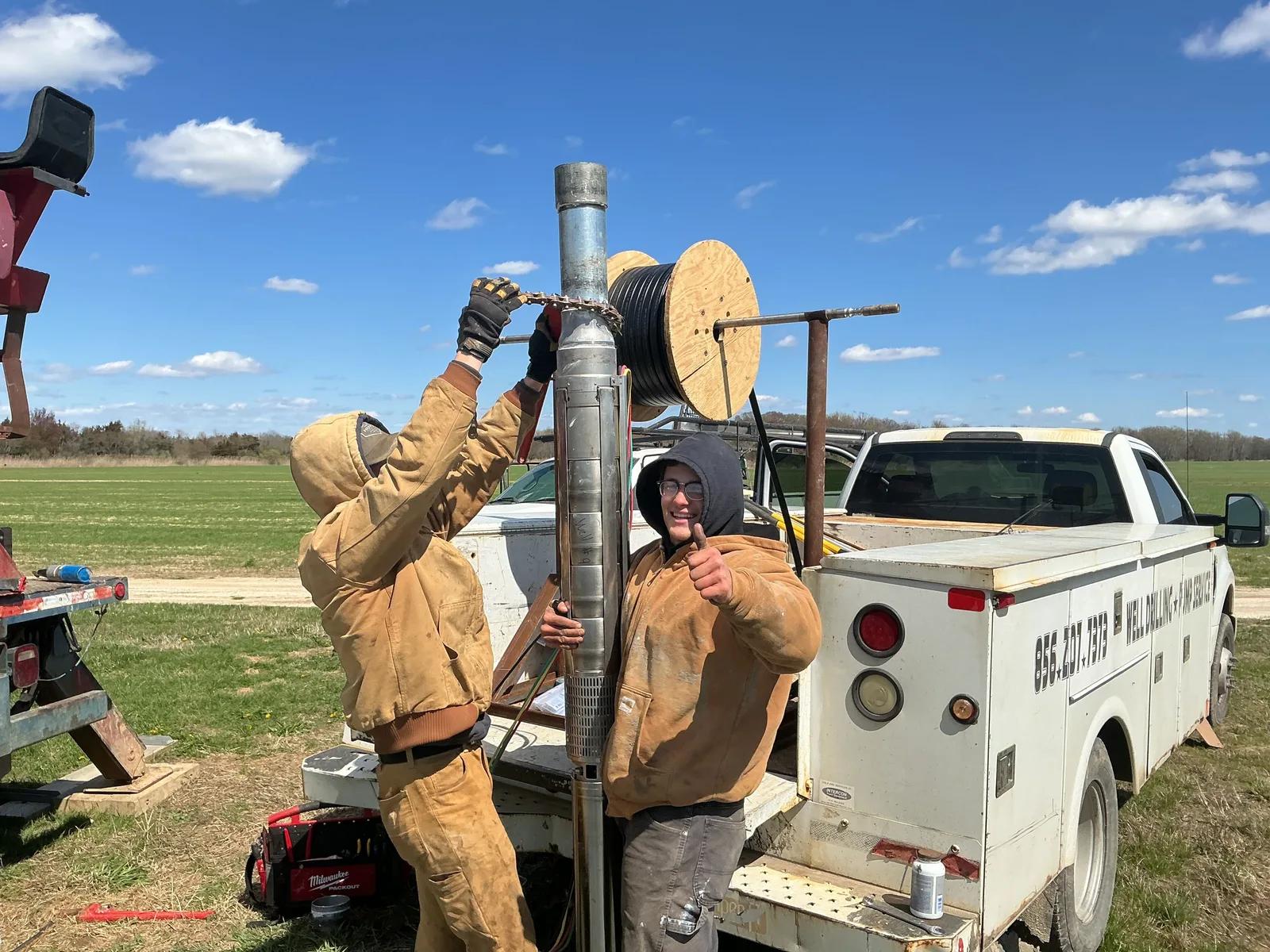
Most swaps are a one-day job: pull the old pump on the drop pipe, measure the well and the water level, set the new pump sized to both the depth and the household demand, new wire spliced and shrink-sealed, torque arrestor and safety rope, then run it until the water clears and the pressure holds. You get the price on site before any wrench turns, and estimates are free. A dead pump does not wait for business hours, and neither do we: (856) 207-7373, answered 24/7.